

Federal Aviation Regulations and rules can get confusing, particularly those pertaining to instrument flight rules (IFR). One in particular I always found confusing, and at times up to interpretation, deals with when a pilot may log an IAP. As you know, logging instrument approaches is an important aspect in abiding
…Category: Ground School
View All CategoriesOnce again, we’re pleased to feature a guest post FAA DPE and CFI Jason Blair. Check out his post from last week on why you should be practicing the glide and his post on flying the traffic pattern from earlier this year. He writes
…This week, we’re pleased to feature guest posts from CFI and FAA DPE Jason Blair! We featured Jason’s excellent write up on flying the traffic pattern earlier this year. He writes his own blog at jasonblair.net.
Gliding is for gliders, right? Well, it’s not just for
…
The success of a flight depends largely on thorough preparation. In the course of your training, a pattern of regular preflight actions should be developed to ensure that this is the case. This includes planning a flight, and checking
…Monday’s post gave us an introduction into the world of gyroscopic flight instruments and as we learned these include the attitude indicator, turn coordinator, and heading indicator also referred to as the directional gyro. Each one of these gyroscopic flight instruments functions based off the principle of rigidity
…
This week we’re looking again at flight instruments. More specifically, gyroscopic instruments. Take a look at what we’ve posted so far on flight instruments, including our CFI’s series on pitot-static systems. This post is excerpted from Bob Gardner’s The Complete Private Pilot.
The attitude indicator, the
…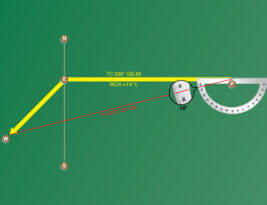
Today, we’ll put together a few things we’ve learned on the Learn To Fly Blog to introduce a skill every beginning student should develop: thinking in terms of a wind triangle. Check out last week’s posts on magnetic variation and using your E6B Flight Computer to
…Plotting a course? Today we’re learning about magnetic variation, with help from Bob Gardner’s The Complete Private Pilot textbook.
For flight planning purposes you must recognize that although the lines of latitude and longitude on charts are neatly perpendicular and relate to the True North Pole there
…