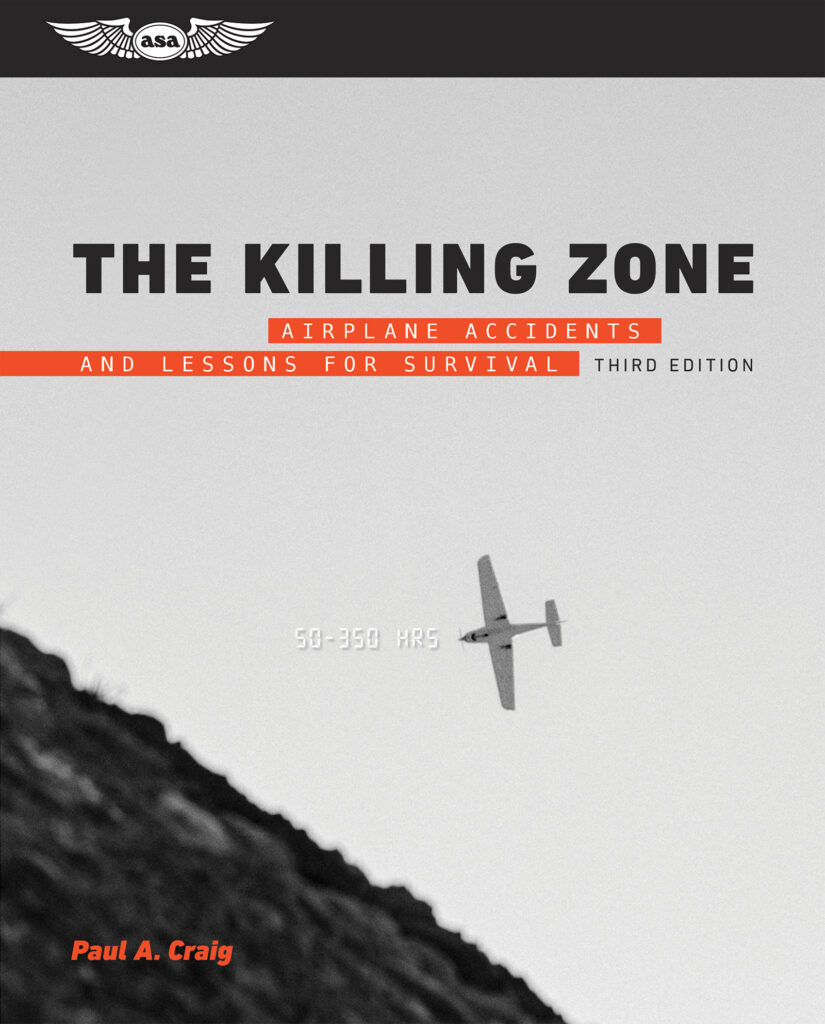
Have you ever wondered what kinds of people become pilots? Are they outgoing or shy, adventurous or careful? Do they like order? Do they relish routine? Because one of the components of aviation safety is the “human factor,” people who spend their time making the air safer for everyone spend time thinking about these questions and how best to mitigate any human weaknesses before there’s a problem. Paul Craig, author of The Killing Zone: Airplane Accidents and Lessons for Survival, is one of those people. He’s compiled research on general aviation accidents and offers ways to decrease the number of errors new pilots make. Along the way, he also answers some questions about who pilots are.
There is a body of research available that indicates that those who fly have different personality traits than everyone else. I always thought that my pilot friends and I were a bit different; now we know that is true. The pilot personality traits are found in military and civilian pilots, professional and personal pilots, and both male and female pilots. When pilots are asked the question: Why do you fly? We give many answers. We say it is fun. We say we love it. We say it is a getaway. We say it is an escape. All that may be true, but it goes deeper than that. Explaining why we fly is difficult to put into words. If we could describe it and were honest with ourselves, we would say that we fly because flying offers us the ingredients that our inner personality needs to thrive.
Eric Farmer, writing for the International Journal of Aviation Safety, says that a number of studies have supported the notion that a distinct pilot personality profile exists and can be identified in successful pilots.1 These studies have identified traits that are found in the pilot personality. The research concludes that pilots are independent achievers who demonstrate competence and enjoy mastering complex tasks. The motivation for flight involves a need for prestige and for control. Those who love to fly desire excitement, power, speed, independence, thrills, and competition.
The people who hire pilots are very interested in what makes a competent pilot and dependable employee. If there are pilot traits that are indicative of a dangerous pilot, they would like to know this in advance so they can hire someone else. Writing in Aviation, Space, and Environmental Medicine, R.A. Alkov spoke of the personality profile of pilots.2 He pointed out that accidents are extremely costly to the aviation industry not only in terms of loss of personnel and equipment, but also because the continued success of the industry, its very existence, depends on the public expectation of safe and reliable travel. The ability to identify an accident-prone pilot would be a valuable asset in the selection process. Factors associated with adventurousness and attitudes toward risk-taking were found to be significantly correlated with accident occurrences among pilots.
Professor, former airline captain, and former FAA employee, Dr. Peter Neff, includes complacency as a trait found in pilots. Neff, writing in the International Journal of Aviation, Aeronautics, and Aerospace, says “complacency is characterized as overconfidence gained through the repetitive performance of a task.”3 Neff connects complacency and aviation: “In the cockpit, repetitive tasks describe the rhythm and choreography of challenge-response or read-and-verify checklist completion protocols that might lead to the memorization of the checklists. Completion of the repetitive tasks through memorization can lead to normalization of deviance and complacency.”
These researchers are telling us that pilots are not normal. We are different from the general population. This is both a terrific and a terrifying thing. The safe pilot in general is mature and motivated to achieve; a well-integrated individual who has a positive self-image, who is curious, active, and able to cope with life’s challenges. Researchers Joseph Novello and Zakhour Youssef conducted research on both male and female pilots. Published in Aviation, Space, and Environmental Medicine in 1974, their studies identified some good and some bad characteristics of the pilot personality.4 The areas specifically identified were achievement, exhibitionism, dominance, acceptance of change, adventure, deference, order, and endurance.
Achievement
Pilots are very goal oriented. A pilot sees a difficult task and enjoys mastering the task. Working to achieve piloting skill, which we perceive as being difficult, feeds our need for personal reward. The pilot personality involves a strong drive to aim for and accomplish difficult tasks. The more difficult the task, the greater the reward. This is why we think very highly of ourselves when we pass a checkride, or fly into and out of a busy airport. We do not merely accomplish something—we conquer it. But this may also be why we might try to scud run under a low overcast, or fly when we are not current.
Exhibition
Pilots not only want to achieve where others fail; we want recognition for the effort. The movies have portrayed the pilot as a romantic hero. Real pilots know there is little romance in electrical systems, weight and balance forms, and performance charts—but we like the image. We want non-pilots to believe that we alone have what it takes to brave the heavens, to cheat death, and, as John Gillespie Magee Jr. wrote in his famous poem, to reach out and touch the face of God.5 Pilots really like to talk about their experiences, and certainly exaggeration is part of the art. When we talk, we like to make the point that what we do could be very dangerous and you really should not try it yourself. For people with the pilot personality, it is usually not enough just to please themselves; they must strike awe into the hearts of others. What endeavor other than flying can do that so readily? But it is also the trait that can push a well-meaning, otherwise safe pilot to buzz a friend’s house.
Dominance
Pilots really like the control that flying gives them. There are very few situations in real life that give a person the kind of total and complete authority as the responsibility of being the pilot-in-command. While on the ground, there are many people and circumstances that control me: my employer, my bills, my family, my hectic schedule. So many things have their hooks in me. I am never in control on the ground. But when I am at the controls of an airplane in flight, I am finally in command. I have power over the situation. The pilot personality needs to feel in control, to dominate the surroundings. Nowhere can such power be obtained better than in an airplane. But being in control might actually blind a pilot to alternatives, suggestions, or options. Nobody can tell me anything—I am in command. A pilot-in-command attitude could blind a pilot to a safer option.
Change
If you like the security of doing the same thing every day, in the same way, on the same schedule, then flying will not suit you. Pilots tend to enjoy doing new things. If you really want to frustrate a pilot, have them sit down and make them do the same task repeatedly on an assembly line all day. The pilot personality gets bored quickly. Once again, piloting an airplane feeds the need for change. While in flight the situation is in a constant state of change. Every flight, every landing, every instrument approach is different from the one before. A pilot sees a flight as being a completely new and different challenge that must be met and overcome. You may travel across the ground between the same two airports for three days in a row, but the wind will be different for each flight. The weather will be different; the load will be different. It is never exactly the same flight. But there are some things that do take place routinely on any flight, like checklists and standard procedures. We are not just being forgetful if we miss a checklist item. It is in our personality to resist the repetition of doing the same old checklist every time.
Adventure
When pilot groups are asked what they would rather do: (A) tour historic Europe; or (B) sail around the world solo, they overwhelmingly prefer the idea of one person against the ocean over listening to a tour guide. Pilots are more likely to seek adventure, to reach the unreachable star. Why climb Mount Everest? Because it is there! Pilots have a “because-it-is-there” spirit. The thought of taking an airplane up against the elements, flying to distant places, and seeing things that the average person only dreams of—this is what drives pilots to the airport. But it can also drive a pilot beyond the role of adventurer and on to being a thrill-seeker.
Flying offers the opportunity to satisfy our need for achievement, exhibitionism, dominance, the need to change, and adventure. We fly because it fits who we are. People who need goals set before them, people who like to talk about personal adventures, or people who push for their own point of view can satisfy those cravings in an airplane. We fly because our inner, complex self is not happy with anything else. Flying has all the right ingredients. We do not choose flying; flying chooses us.
But there is a dark side to these traits. The pilot personality carries some potentially unhealthy baggage. Adventurism can be carried to a dangerous point. Control can reduce teamwork and blind a pilot to good advice. Exhibitionism can go beyond spirited hangar flying to low-level aerobatics. Too much of a good thing can be a bad thing. The pilot personality includes traits that are not good at any level. Pilots have the potential for faulty decision making that goes beyond poor judgment; it is actually part of our personality.
Deference
Pilots do not like to yield to another person’s judgment or will. The pilot personality would rather take charge than be submissive. Pilots do not take criticism well; it goes against our grain. If we need constructive criticism, we reason, then we are not in complete control. Because we want and need control, pilots often reject criticism, argue against it and become hard-headed. This trait can be a real problem and a nightmare in crew resource management situations. If an instructor makes a suggestion that you shallow out your intercept angle, your first reaction may be that the instructor is just picking on you and the angle of intercept you selected is just fine. Doing what the instructor suggested would be an admission that someone else was in control. This is why pilots do not readily come forward with mental health concerns. Seeking help means admitting we need help, and pilots do not want to think they need help.
Several accident examples in [The Killing Zone] were stories of new pilots. They went out and did something foolish soon after being taught to do otherwise. How could this happen? They got their pilot certificate and for the first time they were no longer under the thumb of their flight instructor. They were now in complete control, and they were not going to be told what to do anymore.
Order
Pilots as a group are not as interested in orderliness as the general population. Pilots are not necessarily sloppy people, but spending time to put things in the proper order is just not a high priority. This trait could lead a pilot to overlook details on a preflight inspection or to only partially complete navigation plans. The urge to get into the air may take priority over organizing the cockpit for efficiency. Details can become trivial. Items are overlooked or rationalized as less important.
Endurance
Because the pilot personality likes change, it follows that anything that remains unchanged for long periods of time is uncomfortable. Unfortunately, the knowledge and skills for flying require the learner to show endurance over the long haul. Pilots must stick to it in order to make any progress, but more often pilots will put a task aside when the first diversion comes along. The adventure-seeking traits that first bring the potential pilot to flight training may be overshadowed by the lack of endurance, and the would-be pilot never reaches the goal. There are many more Student Pilot Certificates issued than Private Pilot Certificates.
° ° °
Do not think that being a pilot makes you an uncaring, messy, easily diverted, stubborn hardhead. But these traits, both good and bad, are part of what motivates us to fly in the first place. Taken together, these pilot personality traits reveal a dangerous inconsistency. The same traits that draw a person to become a pilot can work against the pilot. Deep within the pilot personality are the reasons why we fly. We need to fly because flying satisfies and nurtures our personality. But also planted in our personality are the seeds of poor decision making. The same motivation that drives us to the airport may also be our undoing. Put another way, a person who will never take a chance, never be too adventurous, and is perfectly meticulous would be a good pilot. But people with those traits seldom become pilots.
Does this sound like you? Does it sound like pilots you know? Craig also includes a questionnaire that tests whether a person has these qualities (you’ll have to get the book for that). Not all pilots will have all the traits included in the “pilot personality” profile. Many pilots will have them, but in varying amounts—one pilot may love to tell stories, while the next may want to control the situation. Pilots are individuals, but this model hits the broad strokes.
1. Eric W. Farmer, “Personality Factors in Aviation,” International Journal of Aviation Safety (Sept. 1984).
2. R. A. Alkov, J. A. Gaynor, and M. S. Borowsky, “Pilot Error as a Symptom of Inadequate Stress Coping,” Aviation, Space, and Environmental Medicine, 56, no. 3 (Mar. 1985): 244–47.
3. Peter S. Neff, “The Five Hazardous Attitudes, A Subset of Complacency,” International Journal of Aviation, Aeronautics, and Aerospace, 9, no. 1 (2022): n.p., https://doi.org/10.15394/ijaaa.2022.1677.
4. Joseph R. Novello and Zakhour I. Youssef, “Psycho-Social Studies in General Aviation: I. Personality Profile of Male Pilots,” Aviation, Space, and Environmental Medicine, 45, no. 3 (March 1974): 185–88; and Novello and Youssef, “Psycho-social Studies in General Aviation: II. Personality Profile of Female Pilots,” Aviation, Space, and Environmental Medicine, 45, no. 6 (June 1974): 630–33.
5. John Gillespie Magee Jr., “High Flight,” 1941, in Respectfully Quoted: A Dictionary of Quotations Requested from the Congressional Research Service, ed. Suzy Platt (Washington, D.C.: Library of Congress, 1989), 117–18.
Feature photo by Rik at stock.adobe.com.